Let’s be honest—when you hear the word fax, your brain probably jumps to dusty old machines and paper jams from the 90s. But here’s the twist: online faxing is very much alive, and in some places, it’s thriving. One surprising industry that’s embracing online fax technology? Education. Yup, universities, colleges, and even K-12 schools are finding modern ways to make fax work for them—without the bulky machine. So grab a coffee, because we’re diving deep into how this old-school tool is getting a tech-savvy reboot on campus.
What Is Online Fax and How Does It Work?
Online fax, often referred to as e-fax or digital fax, is a modern evolution of traditional faxing that eliminates the need for physical fax machines, paper, or landline connections. Instead, this technology allows users to send and receive fax documents over the internet using cloud-based platforms or dedicated email-to-fax services. By leveraging the convenience of digital infrastructure, users can now manage important document transfers from virtually any device—be it a desktop, laptop, tablet, or smartphone—without being tied to a specific location or hardware setup.
In a typical online fax workflow, users upload a document (such as a PDF, Word file, or scanned image) to a web-based fax service or attach it to an email addressed to a recipient’s fax number, formatted as an email address. The online fax service then processes the file, converts it into a fax-readable format, and delivers it to the recipient’s fax machine or their digital fax inbox. On the receiving end, if the recipient also uses online faxing, the document will be accessible digitally—usually through email or a secure cloud dashboard. If they still use a traditional fax machine, the document is printed out as it would be with a normal phone-line-based transmission.
One of the biggest benefits of online fax is that it maintains the legally accepted format and secure transmission standards of traditional fax, which is still a requirement in many industries like education, healthcare, law, and finance. Unlike regular emails, which can be intercepted or end up in spam folders, online fax platforms often use end-to-end encryption, secure servers, and detailed audit trails, making them ideal for sending confidential information. This makes online fax not just a convenience—but in many cases, a compliance-friendly necessity.
In short, online fax bridges the gap between old-school formality and modern-day efficiency. It takes everything that made faxing reliable—confirmation receipts, legal validity, document fidelity—and gives it a tech-forward twist. Universities, institutions, and businesses that rely on secure, trackable communication are increasingly turning to online fax solutions as a safer and more flexible alternative to traditional document transmission.
Why Should Schools Care About Online Fax?
| Need/Use Case | Traditional Fax | Online Fax | Why It Matters for Schools | |
| Legal Document Transmission | Accepted in courts and by most institutions | May not meet legal/compliance standards | Fully compliant with FERPA, HIPAA, and others | Ensures document validity for student and legal forms |
| Data Security & Privacy | Vulnerable to machine theft and human error | Prone to hacking, phishing, or misdelivery | Encrypted end-to-end with audit trails | Safeguards sensitive student and staff data |
| Accessibility & Remote Use | Location-bound, requires physical presence | Fully accessible but may lack security | Fully accessible from any device, securely | Supports hybrid campuses and remote administration |
| Delivery Speed & Confirmation | Delays from busy machines, no cloud history | Fast but no reliable receipt confirmation | Instant delivery with receipts and time-stamping | Keeps records organized and timely |
| Cost & Maintenance | High: paper, toner, machine upkeep, phone line | Low but lacks reliability and traceability | Low-cost, no hardware, minimal IT involvement | Cuts unnecessary costs while improving workflow |
Top Use Cases of Online Fax in Education and Universities
Online fax plays a vital role in numerous areas within educational institutions, offering a secure, efficient, and compliant way to handle sensitive communications and documentation. Here’s a detailed list of the primary use cases where online fax really shines in the education sector:
- Handling admissions and enrollment documentation, including forms, recommendation letters, and proof of identity. Online fax makes it easier for students and admissions staff to upload and securely transmit personal data, even allowing for handwritten signatures on scanned documents. Some schools provide online fax numbers to streamline document submission, especially for international applicants, avoiding mail delays.
- Managing financial aid and scholarship paperwork that involves highly sensitive information such as Social Security Numbers, tax returns, and bank statements. Online fax ensures encrypted transmission of this data while complying with regulations like FERPA and GLBA, keeping student financial information protected.
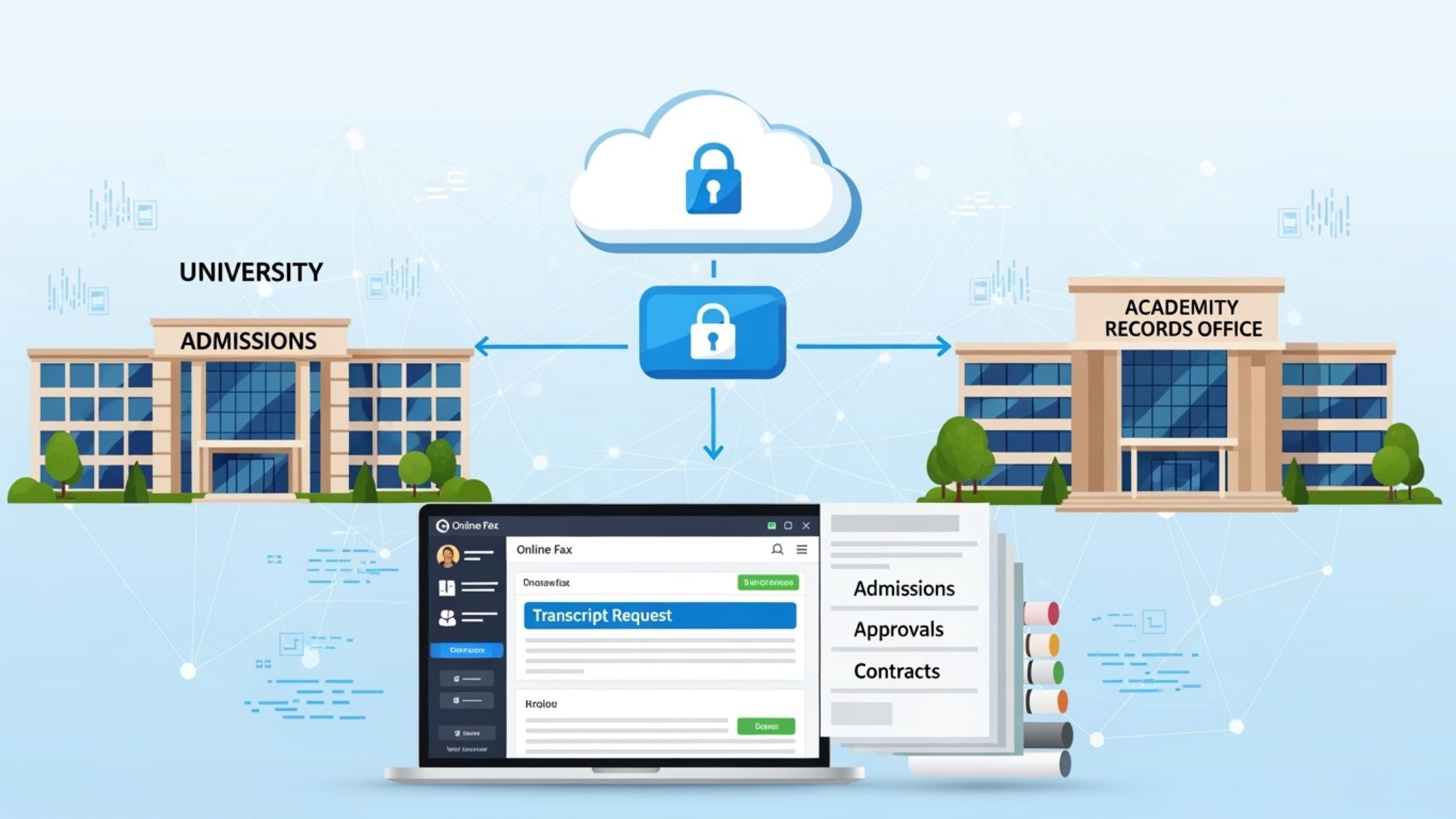
- Processing transcript requests and transfer credits where official transcripts need to be sent quickly and securely. Traditional mail can be slow, and email is not always accepted for official documents. Online fax offers faster delivery, compliance with fax-only document requirements, and time-stamped proof of delivery.
- Supporting registrar’s office operations, which include sending and receiving degree verification forms, name change requests, and enrollment verifications to government agencies. Using cloud fax solutions eliminates the need for printing, allowing registrar staff to manage records entirely digitally and securely.
- Facilitating student health services and the exchange of medical records, including vaccination records, health histories, and insurance claims. Given the sensitive nature of health data protected under HIPAA, universities use HIPAA-compliant online fax platforms to ensure secure, private transmission between clinics, hospitals, and insurance providers.
- Enabling communication within faculty and human resources departments by securely handling faculty contracts, performance evaluations, and benefits forms. Remote faculty can sign and send documents without printing, while HR departments can fax directly from their computers or send forms to third-party services like pension providers.
- Supporting legal and compliance teams in submitting legal notices, receiving subpoenas, and collaborating with external law firms. Online fax guarantees confidentiality, encryption, and full traceability, which are essential for maintaining legal compliance and protecting sensitive university information.
- Facilitating collaboration with other institutions on research projects and student exchange programs. This includes sending signed memorandums of understanding (MOUs), transferring sensitive research data, and sharing joint administrative documents. Online fax provides a universally accepted and painless way to transmit these important files securely.
Key Features to Look for in Online Fax Services for Universities
When universities consider adopting an online fax solution, it’s crucial to understand that not all platforms offer the same level of service, security, or functionality. The nature of educational institutions demands systems that not only simplify document transmission but also meet stringent legal and regulatory standards. For example, compliance with laws like HIPAA and FERPA is non-negotiable because universities regularly handle sensitive personal, academic, and health information. Any online fax service chosen must be able to guarantee encryption and secure handling of data to avoid breaches and maintain student privacy.
Beyond compliance, cloud storage is another critical feature universities should prioritize. Storing faxed documents digitally allows institutions to maintain organized, searchable archives that are easily accessible by authorized personnel. This reduces reliance on physical storage and paper, aligns with sustainability goals, and supports efficient retrieval during audits or compliance reviews. With cloud-based systems, universities can also automate backups, ensuring that important records are never lost due to hardware failure or human error.
Integration capabilities play a huge role in user adoption and workflow efficiency. Universities often require online fax platforms that seamlessly connect with existing email services such as Outlook or Gmail, allowing staff and faculty to send faxes directly from familiar environments. Additionally, mobile app support is vital for campuses with remote or on-the-go personnel, enabling users to send and receive faxes anywhere, anytime. These integrations save time, reduce errors, and eliminate the need for staff to learn entirely new systems or workflows.
Finally, the scalability and flexibility of the service are key considerations. Universities are complex organizations with many departments, each potentially needing its own fax number for administrative clarity. An ideal platform offers multiple fax numbers and supports unlimited users, ensuring it can grow alongside the institution. Moreover, audit trails that track every fax sent and received are indispensable for legal verification and compliance monitoring, helping universities demonstrate due diligence when handling sensitive documents. Altogether, these features make a comprehensive online fax service a powerful tool in modern educational administration.
Benefits of Using Online Fax in Education
| Benefit | Description | Why It Matters in Education | Impact on Operations | Example Use Cases |
| Security | Online fax uses encryption, authentication, and compliance protocols to protect data. | Protects sensitive student records, health info, and financial data. | Reduces risk of data breaches and unauthorized access. | Sending medical records, financial aid documents securely. |
| Time Savings | Eliminates the need to physically use fax machines or wait in line. | Streamlines administrative processes and speeds up document exchange. | Staff can complete tasks faster and handle more requests. | Admissions sending application documents quickly. |
| Accessibility | Enables sending and receiving faxes from anywhere via computers or mobile devices. | Supports remote staff, hybrid learning models, and multi-campus setups. | Improves flexibility and continuity of operations. | Faculty submitting contracts from off-campus locations. |
| Cost Effectiveness | Removes costs associated with paper, toner, fax machine maintenance, and phone lines. | Helps educational institutions reduce overhead and budget expenses. | Lowers operating costs and IT resource requirements. | Registrar’s office reducing physical fax infrastructure expenses. |
| Legal Compliance | Maintains adherence to regulations like FERPA, HIPAA, and other data privacy laws via secure fax. | Ensures educational institutions meet legal standards for document handling. | Minimizes risk of fines and legal issues from non-compliance. | Transmitting student transcripts and health records securely. |
Challenges Schools Might Face with Online Fax (And How to Solve Them)
Adopting online fax technology in educational institutions can bring a lot of benefits, but it also comes with several challenges. Here’s a detailed and comprehensive list of common obstacles schools might face along with practical solutions to overcome them:
- Staff Resistance to Change
Many faculty and administrative staff may be comfortable with traditional fax machines and reluctant to switch to an unfamiliar digital system. Fear of technology, lack of confidence, or simply preferring “the old way” can slow adoption.
Solution: Provide thorough training sessions tailored to different skill levels, emphasizing how online fax saves time and reduces hassle. Share success stories and allow staff to practice using the new system with support readily available. - Budget Constraints and Cost Concerns
Educational institutions often have limited budgets, which can make investing in new technology challenging. The upfront costs or subscription fees might seem prohibitive, especially if the benefits aren’t immediately clear.
Solution: Start by implementing online fax in high-volume departments like admissions or financial aid to quickly demonstrate ROI through saved time and resources. Gradually expand to other departments once the cost-effectiveness is proven. - Integration with Existing IT Systems
Schools use a mix of software for email, cloud storage, Student Information Systems (SIS), and document management. If an online fax system doesn’t integrate smoothly with these platforms, it can create extra work or duplicate efforts.
Solution: Choose an online fax provider with strong integration capabilities, allowing seamless connection with popular email clients, cloud drives, and SIS. This ensures smooth workflows and minimizes manual handling. - Faxing to Traditional Machines and Legacy Systems
Not all recipients—whether other schools, government bodies, or vendors—have upgraded to digital fax solutions. Incompatibility between online fax and older analog fax machines can cause failed transmissions or delays.
Solution: Verify that the online fax service supports fax-to-fax communication, ensuring compatibility with traditional machines. This avoids disruptions when communicating with partners still using legacy fax hardware. - Ensuring Compliance with Legal and Privacy Regulations
Handling sensitive student and staff data means adhering to strict privacy laws like FERPA, HIPAA, and GLBA. Choosing the wrong fax solution could risk non-compliance and penalties.
Solution: Work with online fax providers who offer full compliance certifications, secure encryption, and detailed audit trails. Train staff on compliance best practices when transmitting confidential documents. - Technical Issues and Connectivity Dependence
Since online fax relies on internet connectivity, outages or slow connections can disrupt sending and receiving important documents, potentially delaying critical processes.
Solution: Implement reliable internet infrastructure with backup connections if possible. Educate staff on troubleshooting basics and provide IT support to quickly resolve issues. - User Experience and Accessibility Challenges
Some users may find the online fax interface unintuitive or face difficulties accessing the service on different devices, especially mobile phones or tablets. This can reduce productivity and cause frustration.
Solution: Select user-friendly platforms with mobile apps and simple interfaces. Offer ongoing user support and update training materials regularly to address common challenges. - Security Concerns Over Data Transmission
While online fax is generally secure, staff may worry about interception or unauthorized access to confidential faxes, particularly when using public or unsecured networks.
Solution: Choose providers that use end-to-end encryption and secure servers. Encourage users to avoid sending sensitive information over public Wi-Fi or to use VPNs for extra protection.